

The line between Tourette Syndrome and OCD can be a little hazy for some people.
Sometimes, tics are carried out to reverse an intrusive thought. On other occasions an OCD-style compulsion may feel ‘just right‘ or help to scratch a ‘mental itch’.
Tourettic OCD -or Just Right OCD– may more accurately define someones experiences and help to improve quality of life.
Having a bridge between the two will no doubt help some to better understand their mind.

A much needed link
This relatively recent term is much welcomed. Many sufferers have longed for a more accurate label for an experience that isn’t fulfilled by a Tourette or OCD diagnosis alone.
The International OCD Foundation provides a useful article on the relationship between Tourette and OCD, as well as the following paragraph on TOCD:
...boundaries between symptoms of OCD and T/TS can be blurry, especially with regard to differentiating complex tics from compulsions in cases where actions are repeated specific numbers of times according to prescribed rules or until a “just right” feeling is achieved.
IOCDF- Distinguishing Features of TOCD
‘Blurry’ is the key word here.
Understanding when TS and/or OCD is taking hold can be difficult enough on their own. Even more so when they occur concurrently.
The following list provides examples of how TOCD may occur, with the hallmarks of both Tourette and OCD present.
- Switching a light on and off repeatedly, until a sensation in the finger goes away
- Having three head nodding tics in a row, and needing to do a fourth because even numbers ‘feel right’
- Saying a ‘good’ word out loud after saying or thinking a ‘bad’ word. Saying the ‘good’ word provides relief or a feeling of ‘evening things out’
OCD-style compulsions due to a sensory feeling
Sometimes behaviours typically linked with OCD are caused by a feeling and not a thought or fear.
Repeating an action (such as locking a door or pressing a switch) may be carried out because of a need to hear the sound of the lock, or feel the finger press against the switch.
These may be considered complex tics, but can also fall under the category of Tourettic-OCD.

Tourette closely followed by OCD, and vice versa
On occasions, symptoms of Tourette and OCD may occur separately, but in quick succession.
For example, someone with a dislike of odd numbers may feel anxiety if a tic is carried out three times.
In this case, a fourth ‘phantom’ tic would be carried out. This action would not be to alleviate the pressure built from a tic, but to satisfy the need to do things an even number of times.
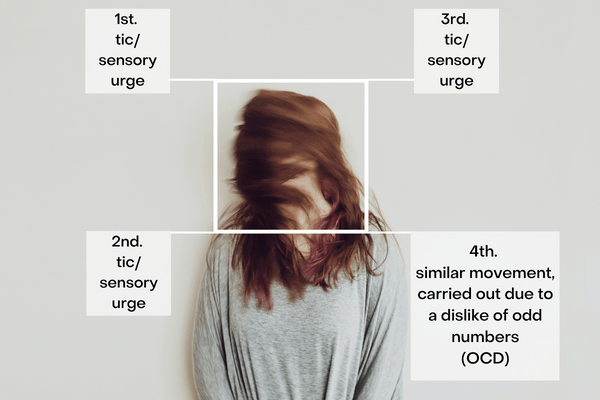
'Phantom' tics reversing intrusive thoughts
Compulsions may appear identical to tics in Tourette, and very difficult to distinguish without context.
For example, someone struggling with intrusive thoughts on a religious theme may say ‘Heaven’ out loud when thinking of Hell, or apologise to God after an intrusive thought.
These differ from vocal tics as the words are said to reverse a thought, and not due to a sensory urge.

How common is Tourettic-OCD?
Tourette’s affects roughly 1% of the population, and OCD 2.3%.
Tourettic OCD will no doubt be a number within these figures, although there isn’t much information on this.
In the same article at International OCD Foundation linked above, it states that 60% of Tourette’s sufferers experience OCD symptoms. It goes on to say that 50% of children with OCD have tics, and 15% meet the criteria for Tourette’s Syndrome.
It seems that if you have one of these conditions, there is a chance you have both.
The difference between Tourette and OCD
It can be hard to distinguish one condition from the next, especially if they both share similar characteristics. Tourette’s and OCD both consist of urges, compulsions and seemingly irrational behavior.
I felt it would be valuable to put this down in writing from my experience.
Tourette, for me, is more action based. It starts with an urge, like a mental itch, that you need to ‘scratch’ either with a body movement or a sound or phrase. OCD focuses more on thoughts, often uncomfortable, scary or disgusting, and followed by a process to try and eradicate or reverse those thoughts.
Table of information showing difference between Tourette's and OCD
| Tourette’s Syndrome (TS) | Obsessive Compulsive Disorder (OCD) | |
| Disorder type | Neurodevelopmental/Motor/Tic Disorder | Mental/Anxiety Disorder |
| How common? | 1% of population | 2.3% of population |
| Who is affected? | Anyone, however 3-4 times more likely in males | Anyone, males and females affected equally |
| Classic symptoms | Head nodding, shoulder shrugging, blinking, grunts, coughs, shouting words/phrases | Intrusive thoughts, ruminating, excessive checking, cleaning, ordering, hoarding |
| Symptom development | Often in childhood | Usually before 35 years of age |
| Is there a cure? | Not currently | Not currently |
| Therapies | Exposure and Response Prevention (ERP), Habit Reversal Therapy (HBT) | Exposure and Response Prevention (ERP) |
How I tell the difference
As a child I recall both conditions taking control of my life. I would have the urge to touch things a lot, especially the floor or my knee numerous times a day. I would also need to read a book in a specific style, making a mistake would mean I would have to start all over again. The same with video games. I would have a routine I had to stick to and if I messed up, back to the start.
Touching things was a classic Tourette’s tic. The urge was simply an itch that wouldn’t go away until I scratched it. No uncomfortable thoughts or a need to reverse anything, just an movement that I needed to do to relieve the pressure in my mind. This is a motor tic, more on these can be read in my post What are Tics?.
When reading, OCD came into play. If I didn’t read the title out loud, followed by the sub-title, followed by the blurb on the back cover, I couldn’t open the book. If I made a mistake in either the introduction or first chapter, I would have to start the process again.
This is the ‘contamination‘ type of OCD. I couldn’t carry on because I would constantly think about having an imperfect start to the book, and this would ruin the whole book. It would be contaminated by negative thoughts of imperfection, anxiety and stress. I would recommend more reading on types of OCD in my post What is OCD? if you are new to the condition.
Don’t worry if this may seem a little confusing. These conditions are rare, vary a lot and can share many similarities. Despite having them for over twenty years I still find myself questioning a lot of it!
Can they overlap?
At times I do feel these conditions overlap, or at least work together very closely.
One example of this is a blinking tic I do from time to time. Sometimes, the urge to blink comes up and I do it. Another pops up almost immediately, and another. I do them and I can finally rest. There is no special number of times I have to do a tic, again like an itch. They just come and go as they please.
Then, my OCD kicks in and registers that I only did it three times. I feel the urge to do a fourth one so it ends on a nice even number. The Tourette’s was the first three, the last one was an OCD compulsion. Different feelings manifested before the compulsions, despite the compulsion being exactly the same. An itch for the first ones, and more anxiety and the need for order for the fourth one.
This is when Tourettic OCD comes into play.